

Agent Families
Two families of agent run in the hub. Both read live MoEngage data, run in the background, and record every task in the same list.
For what each family covers in depth, refer to Global Agent and Custom Agents.
The rest of this page applies to both families except where a callout marks a section as specific to one.
Reach the Hub
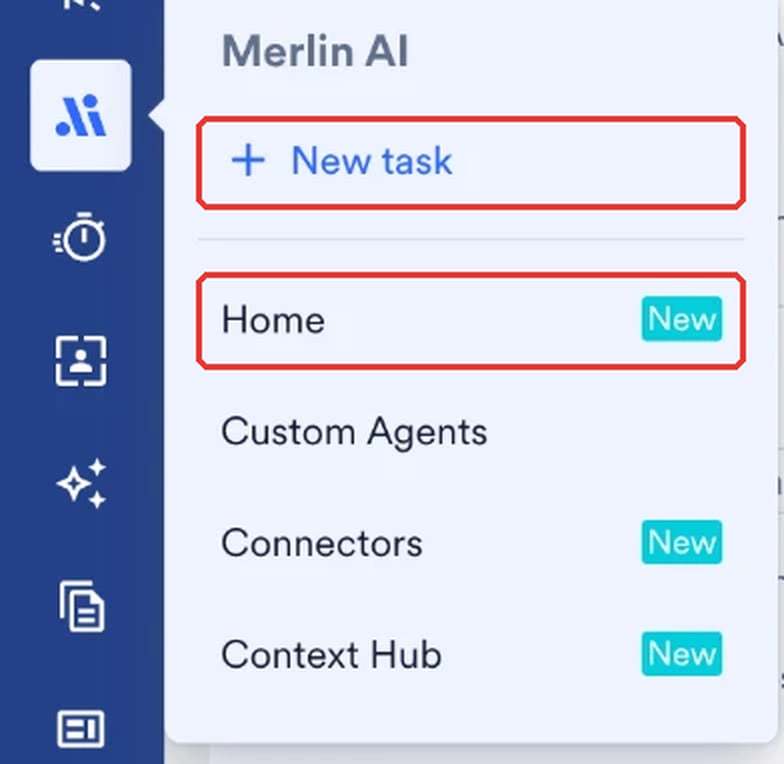
Hover over Merlin AI in the left menu. Two items open the Merlin AI Agents hub:- New task opens the composer, where you describe the work.
- Home opens the hub, which lists your custom agents, your recent tasks, and the templates available to you.
Start a Task
PrerequisitesBefore you begin, ensure the following:
- The agent family you want to run is enabled for your workspace. Refer to Feature Enablement. A Custom Agent must also be in a Live state, so refer to Publish the Agent.
- You have access to the MoEngage data your request depends on, such as campaigns, segments, or analytics.
1
Open the composer
Hover over Merlin AI in the left menu and click Home, or click New task to open the composer directly.
2
Select the agent
Click Select agent and choose Global agent or one of your Live Custom Agents. Every task runs on one agent, so select the agent before the task starts.
3
Select a mode
Choose Fast, Balanced, or Expert. Balanced is the default mode, and the mode locks once the task starts, so to use a different mode, start a new task.The Global Agent sets the mode for each task. A Custom Agent sets the mode on the agent instead, so the control does not appear when you select a Custom Agent before the task starts. After the task starts, the control shows the agent’s mode and stays locked. For what each mode does, refer to Choose a Mode.
4
Describe the work
Write what you want in plain language, and then send the message.
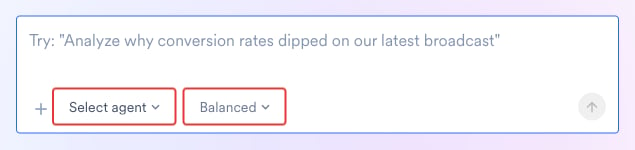
The first message starts the run: the agent begins work as soon as the message arrives.
Agents rely entirely on your instructions and the context you provide. Supplying necessary IDs, dates, or reference briefs in your first message prevents unnecessary back-and-forth and improves output accuracy.
Attach Files to a Task
Select the plus icon in the composer to attach files to any message, including the first message. The agent reads each attachment as part of the same turn. Send a CSV of campaign IDs or a brand guideline document, and the agent works from the attached file.Files you attach to a message apply to that conversation alone. To attach reference files that MoEngage includes with every run of a Custom Agent, refer to Attach Files.
Parts of a Task View
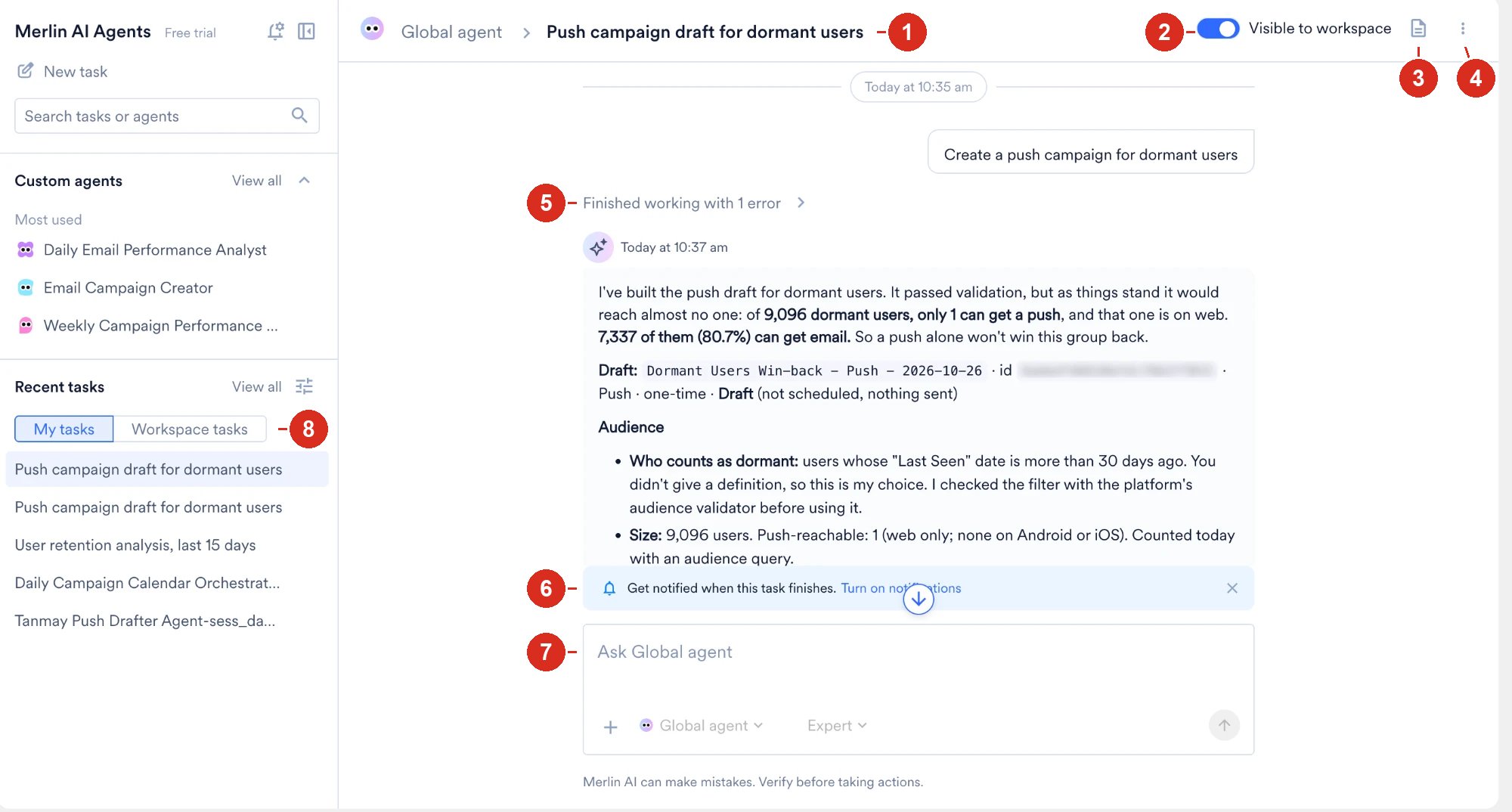
- Agent and task name. The breadcrumb names the agent the task runs on, followed by the task name. To change the name, refer to Rename a Task.
- Visible to workspace. Switches whether your colleagues find the task under Workspace tasks. For more information, refer to Change Task Visibility.
- Output files. Opens the panel that lists every file the run produced. For more information, refer to Review Task Outputs.
- Task menu. Pins, renames, copies a link to, and archives the task. For more information, refer to Task Menu.
- Finished working. Expands the steps the agent took, including any error the agent encountered.
- Notification banner. Turns on a browser notification for when the task finishes. For more information, refer to Notifications.
- Composer. Sends your next message in the same task. The agent picker and the mode control sit below the message box.
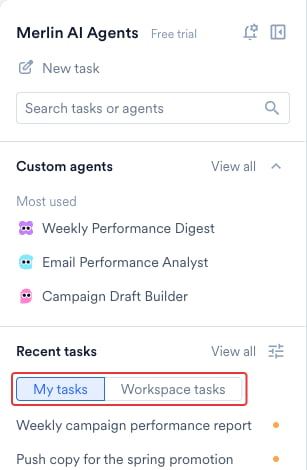
- My tasks and Workspace tasks. Switches the Recent tasks list between your own tasks and the tasks shared with your workspace. For more information, refer to Recent Tasks.
The Left Pane
Recent Tasks
Under Recent tasks in the left pane of the hub, switch between two tabs. Each task appears under exactly one tab.
Copy link becomes available once the task is visible to your workspace.
A colleague’s task appears under Workspace tasks in either of the following cases:
- The task is a Global Agent task, and the task owner leaves the task visible to the workspace.
- The task is a run of a Custom Agent that your workspace publishes publicly. For a Custom Agent run, the agent’s visibility decides whether colleagues see the run.
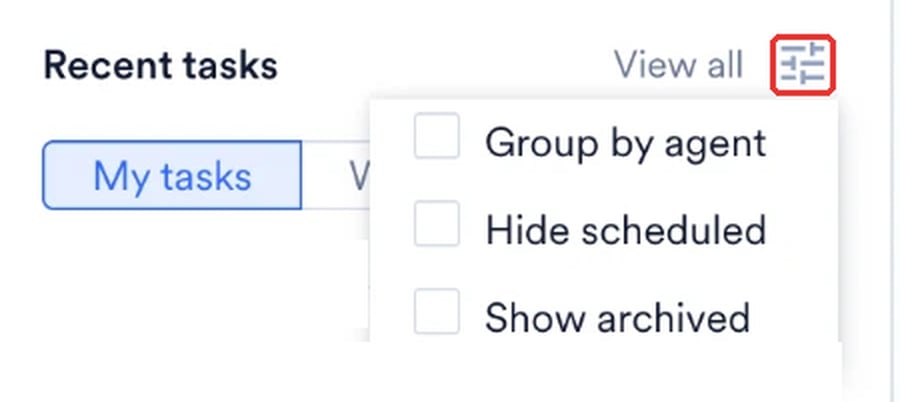
Change the Task List View
Custom Agents only. Hide scheduled affects scheduled Custom Agent runs. Global Agent tasks are always manual, so the option does not change a list of Global Agent tasks.
Search Tasks and Agents
Press Enter in Search tasks or agents, or select the magnifier, to open search. The results carry Tasks and Agents tabs, and a search needs at least two characters. Narrow the Tasks tab by time range, by run type, and by whether a task is active or archived. To open a specific task, paste the task’s Session ID into the search field.The Custom Agents Section
Custom Agents only. This section of the left pane lists Custom Agents. The Global Agent is not listed here, and you select it from the agent picker in the composer.
Find a Task
Filters Above the Table
Click View all next to Recent tasks to open the All tasks page, which carries the filters. Three filters sit above the table:
Select run date offers Today, Yesterday, Last 7 Days, Last 30 Days, This Month, and Custom Range. Pick the dates on the calendar for a custom range, then click Done. Reset clears the range.
Filters in the Filters Panel
Click the filter icon to open the Filters panel, which holds three more filters: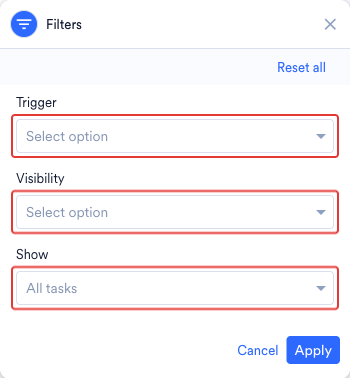
The Visibility filter switches between the same views as the My tasks and Workspace tasks tabs. To set whether your workspace sees a task, refer to Change Task Visibility.
All Tasks Columns
The All tasks page lists every task with the following columns:
When a scheduled run finishes or fails, MoEngage emails the agent’s creator the run’s outcome, Task ID, run date, duration, and next run time. The email leaves out the run’s output. The creator turns the email off with the Email toggle on the agent. For more information, refer to Configure Notifications.
Open a Task
On the All tasks page, select a task row to open a preview panel beside the list. The panel shows:- The transcript of the task, including what the agent returned.
- Finished working, which expands the steps the agent took.
- Who last ran the task, and when.
Task Menu
Each task in the left pane carries a task menu. On a task you own, the menu holds the following actions:- Copy link
- Rename
- Pin and Unpin
- Archive and Unarchive
- The Visible to workspace switch
Pin a Task
Pin a task to find the task quickly in the task list:- Your pins are yours alone, and your sidebar holds up to 50 pinned items.
- You pin any colleague’s Global Agent task that you can see.
- When the task owner archives a task, the task leaves every user’s pins.
Rename a Task
Each task starts with a title that MoEngage writes for the task. A scheduled run is titled with the agent’s name and the run’s scheduled time in UTC. Rename a task to describe the task in your own words. Only the task owner renames a task. Select Rename in the task menu, enter a title of up to 120 characters, and click Save. The dialog counts the characters as you type.Change Task Visibility
Who can open a task depends on the agent family:- Global Agent
- Custom Agents
Global Agent tasks are visible to your workspace by default. As the task owner, you control a task’s visibility with the Visible to workspace switch:
- Switch on: Any user in your workspace finds the task under Workspace tasks, opens the task transcript, and reads the task outputs.
- Switch off: The task leaves Workspace tasks, and only you open the task from the task list.
Copy a Task Link
Select Copy link in the task menu to copy the address of the open task. The option becomes available once the task is visible to your workspace, and the link works only for users who have permission to view the task.Archive and Restore a Task
Archive a task to take the task off your active list. Only the task owner archives or restores a task. Archiving a task has the following effects:- MoEngage keeps the transcript and the output files.
- The task leaves every user’s pins.
- The task opens again once the owner restores the task.
1
Show archived tasks
Select the view options icon beside Recent tasks and turn on Show archived. On the All tasks page, open the Filters panel and set Show to Archived only instead.
2
Find the task
Locate the task in the list.
3
Restore the task
Select Unarchive in the task menu, or open the task and select Unarchive and open.
What a Colleague Does on Your Task
When a colleague opens a task that you own, a notice replaces the message box, so the conversation stays yours to continue. A colleague can:- Read the full transcript and the output files.
- Copy the task link.
- Copy the session ID.
- Pin the task to their own sidebar.
FAQs
Who can see the tasks I run?
Who can see the tasks I run?
Global Agent tasks are visible to your workspace by default, and the task owner changes a task’s visibility at any time. A Custom Agent run follows the visibility set on the agent. For more information, refer to Change Task Visibility.
Can I continue a task that a colleague started?
Can I continue a task that a colleague started?
You read a colleague’s task in full, including the transcript and the task outputs. The task owner continues the conversation.
Why can't I find an older task in search?
Why can't I find an older task in search?
The Tasks tab in search covers the last 30 days by default. Widen the time range to reach an older task, or open the All tasks page and use Select run date.
Next Steps
Run and Manage Tasks
Follow a running task, read a transcript, review outputs, and understand agent memory.
Global Agent
See the categories of work the ready-to-use Global Agent handles.
Build a Custom Agent
Turn a job you repeat into an agent with its own instructions, tools, and schedule.